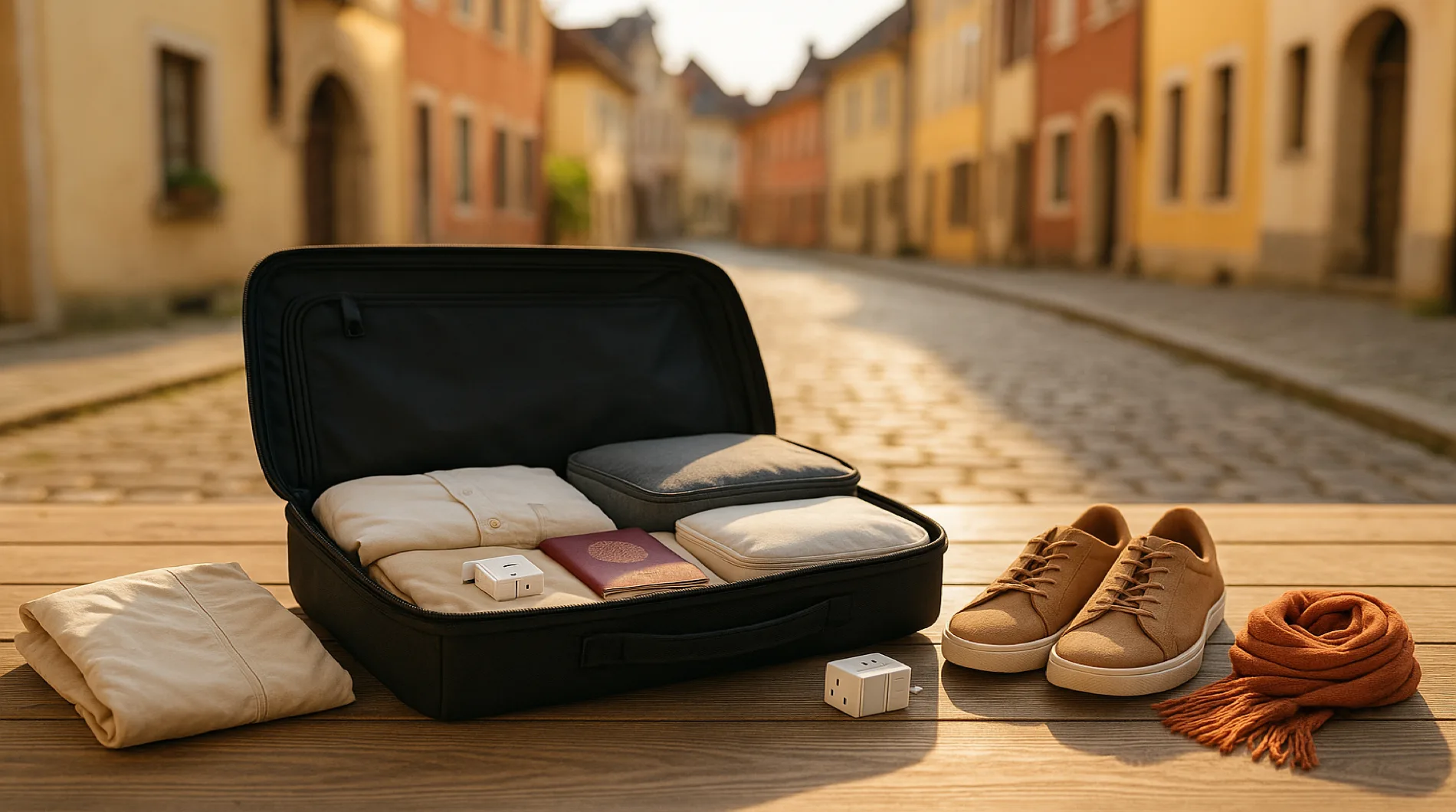
Europe is one of the world's most rewarding travel destinations — and one of the most deceptive to pack for. You're visiting multiple countries, potentially across seasons, on streets built centuries before rolling suitcases existed. Here's how to pack for Europe the smart way.
Understanding the European Travel Context
Before you pack, understand what makes European travel unique:
- Multi-country trips are common: Many visitors to Europe spend time in 3-8 countries in a single trip. Your bag needs to work across all of them.
- Public transit is the primary transport: Trains, metros, trams, and ferries. Rolling bags on cobblestones are a nightmare — a backpack or soft-sided bag is strongly preferred.
- Climates vary enormously: A trip to Europe in May might include cool, rainy Paris, sunny Rome, and chilly Scotland — all within two weeks.
- Cities are walkable: You'll walk 10-20km per day in most European cities. Footwear is not a place to compromise.
The Power Adapter Situation in Europe
Most of continental Europe uses the Type C (round two-pin) or Type F plug with 230V electricity. The UK and Ireland use Type G (three rectangular pins). Switzerland uses Type J.
- If you're visiting multiple European countries, a universal adapter covers all of them
- Most modern electronics (laptops, phone chargers, cameras) handle 110-240V automatically — check your device label
- Items that often DON'T auto-convert: hair dryers, curling irons, electric shavers
- Bring one good universal adapter rather than country-specific adapters
Schengen Zone: What You Need to Know
The Schengen Area covers 27 European countries with open borders between them. For travelers, this means:
- No passport checks when crossing between Schengen member states
- Non-EU visitors typically get 90 days within any 180-day period across the entire Schengen zone — not per country
- Your entry stamp is at the first Schengen country you enter, and your 90-day clock starts there
- Keep track of your days — overstaying a Schengen visa has serious consequences
- Countries NOT in Schengen include the UK, Ireland, Bulgaria, Romania, Cyprus, and some Balkan countries — each has separate entry requirements
Footwear: The Most Important European Packing Decision
This cannot be overstated: comfortable, broken-in, supportive walking shoes are the single most important packing decision for a European trip. Cobblestones, medieval staircases, long days on foot — Europe will test your footwear.
- What works: Comfortable leather sneakers, supportive walking shoes, well-worn loafers, trail runners. Choose shoes that look reasonably "city-appropriate" but above all, prioritize comfort.
- What doesn't work: New shoes not broken in, flat sandals with no support, flip flops as your main walking shoe, heels for daily sightseeing
- Most experienced European travelers recommend: 1 pair of versatile walking shoes worn on travel days, and 1 pair of slightly nicer but still comfortable shoes for evenings
Dressing for Multiple European Climates
The layering system is your best friend in Europe, where weather changes quickly and a single trip often spans multiple climate zones.
- Spring (March-May): Cool mornings, mild afternoons, potential rain. Pack: light layers, a waterproof jacket, comfortable pants, and a thin sweater.
- Summer (June-August): Hot in the south (Spain, Italy, Greece), mild in the north (Scotland, Scandinavia). Pack: light clothes for the south, a medium layer for northern Europe, always a light rain layer.
- Autumn (September-November): Variable — can be beautiful warm weather in September, quite cold by November. Pack: versatile mid-layers and a warmer jacket.
- Winter (December-February): Cold to very cold across most of Europe. Pack: proper winter layers, warm coat, gloves, hat.
European Style: Blend In, Don't Stand Out
Europeans tend to dress slightly more "put together" than casual American or Australian tourist attire. This isn't about being formal — it's about avoiding looking like a visible tourist (which can attract pickpockets and unwanted attention).
- Avoid: bright tourist t-shirts, baseball caps worn backward, athletic shorts in city centers, fanny packs worn visibly on the front
- Do pack: neutral, versatile clothing in darker or classic colors, a scarf (very European and very functional), comfortable but presentable shoes
- A scarf in particular is one of the most useful European travel items — it keeps you warm, looks intentional, and can cover shoulders at religious sites
Bag Choice for Europe
Your bag choice matters more in Europe than almost anywhere else:
- A carry-on backpack (35-45L) is ideal for most European trips. It navigates cobblestones, fits on trains, and avoids checked bag fees on low-cost carriers like Ryanair and easyJet — who charge significantly for checked luggage.
- A smaller daypack or packable bag for daily excursions while your main bag stays at the accommodation
- Anti-theft features: Hidden zippers and cut-resistant straps are worth considering in busy tourist cities
Budget Airlines in Europe
If you're using budget carriers (Ryanair, easyJet, Wizz Air, etc.) to hop between European cities, know their strict bag rules:
- Most budget airlines have very small personal item allowances — as small as 40x20x25cm for free
- Carry-on bags often require an upgrade fee unless you have a premium ticket
- Checked bags on budget carriers can cost €30-50+ each way
- Pack light and check your specific airline's bag policy before each flight
Currency, Payments, and Cards
- Most Western European countries use the Euro — but not all. Switzerland uses CHF, Sweden uses SEK, Norway uses NOK, Denmark uses DKK, Poland uses PLN, the UK uses GBP.
- Card payments are widely accepted, but have some cash for markets, smaller restaurants, and tips
- Notify your bank of travel plans and carry 2 different cards in case one is blocked or lost
Your European Packing List Essentials
Build your Europe-specific packing list in Packy before your trip. The consistent elements — adapter, walking shoes, layering system, anti-theft bag — stay the same across European trips. The variables — climate-specific layers, visa documentation — change per destination and season. Having a template means you never forget the European-specific items that are easy to overlook until you're already there.